Covalent bonding in methane (CH₄)
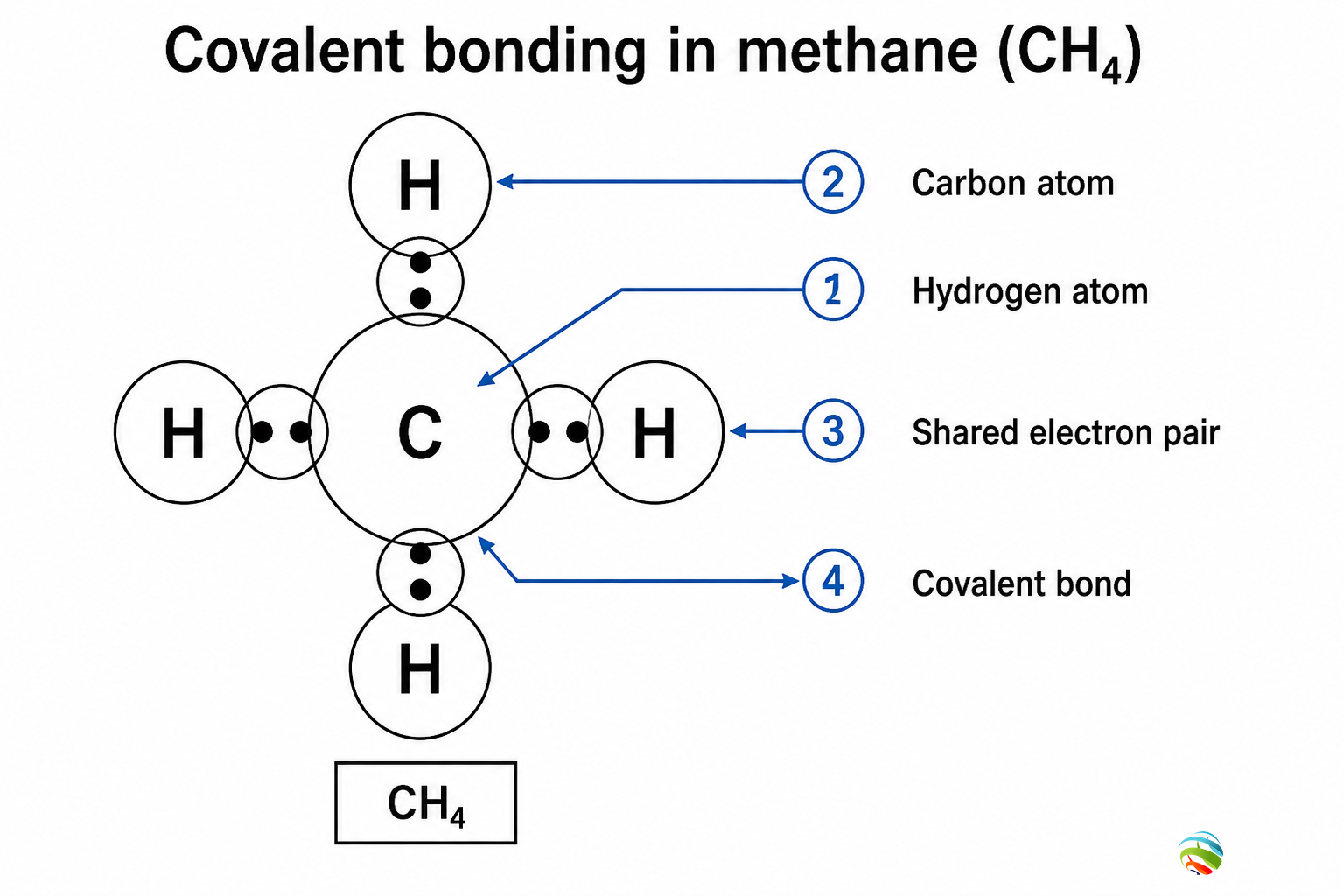
Carbon shares four electron pairs with four hydrogen atoms.
Step 1 — Study the figure
Cover the label key on the image, name each numbered part, then check the explanations below.

Step 2 — Diagram details for students
What this diagram shows
Carbon forms covalent bonds by sharing electrons, shown here in methane CH₄. Carbon is tetravalent, so it forms four bonds, which helps explain the huge variety of carbon compounds. Covalent compounds generally differ from ionic salts in melting point and conduction.
Numbered parts — mark & remember
Match each number on the figure with the meaning below. Say the function aloud once.
1 Carbon centre
Carbon has four valence electrons and needs four more for an octet. In methane it sits at the centre bonded to four hydrogens. This tetravalency is a core Class 10 idea for carbon chemistry.
2 Hydrogen atoms
Each hydrogen shares one electron pair with carbon. Four hydrogens satisfy carbon’s four bonds and each hydrogen’s duet. The molecular formula becomes CH₄.
3 Shared pairs
A covalent bond is a shared pair of electrons between atoms. In electron-dot diagrams you show dots/crosses; in structural formulae you show lines. Both styles are accepted if clear and complete.
4 Methane molecule
Methane is the simplest hydrocarbon and a common domestic fuel example. It is covalent, so it does not conduct electricity like ionic salts. Use CH₄ whenever a simple covalent example is needed.
How to read this figure
- Count four bonds around carbon — no more, no less in methane.
- Shared pair = covalent bond; transferred electron = ionic bond.
- Link tetravalency and catenation to carbon’s versatility.
Redraw for board marks
- Place C in the centre and four H around it.
- Show shared pairs as dots or bond lines.
- Label CH₄ clearly beside the figure.
Board answer tip: Draw electron-dot or structural CH₄, state that bonds are covalent shared pairs, and mention tetravalency.
Exam tips — don’t lose marks
- Tetravalency + catenation explain why carbon has so many compounds.
- Covalent compounds usually have low melting/boiling points compared with ionic salts.
- Do not mix ionic transfer language into methane bonding answers.