Types of chemical reactions (map)
Combination, decomposition, displacement, double displacement, and redox at a glance.
Step 1 — Study the figure
Cover the label key on the image, name each numbered part, then check the explanations below.

Step 2 — Diagram details for students
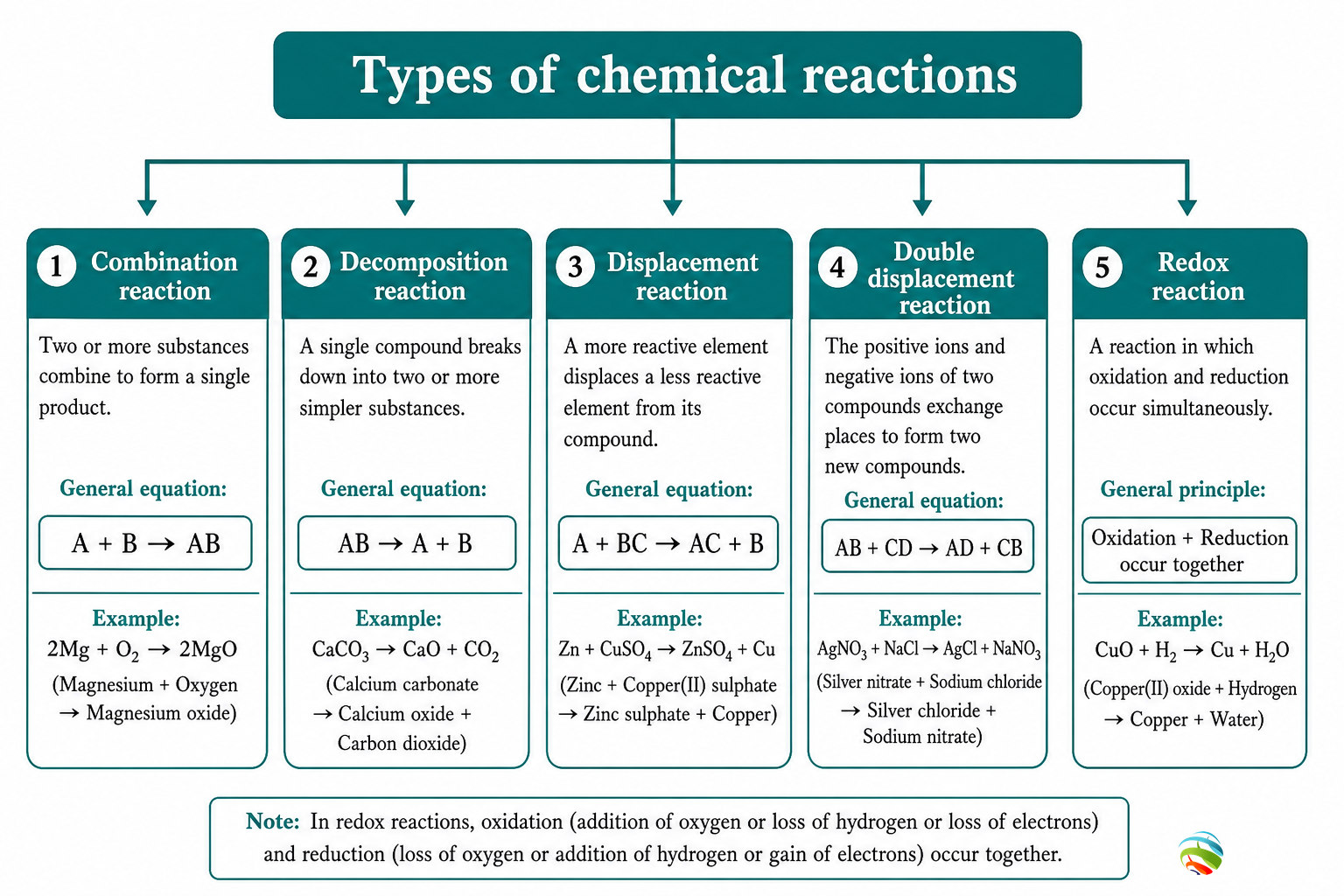
What this diagram shows
This map classifies Class 10 chemical reactions so you can recognise the type from any given equation. First count reactants and products, then check for displacement or ion exchange. Some reactions can fit more than one type, especially combination with redox.
Numbered parts — mark & remember
Match each number on the figure with the meaning below. Say the function aloud once.
1 Combination
Two or more reactants join to form a single product: A + B → AB. Example: carbon burns in oxygen to form carbon dioxide. If oxygen is added, the same reaction may also be called oxidation/redox.
2 Decomposition
One compound breaks into two or more simpler products: AB → A + B. Heat, light, or electricity often supply the energy. Example: heating calcium carbonate gives calcium oxide and carbon dioxide.
3 Displacement
A more reactive element pushes out a less reactive one from its compound: A + BC → AC + B. Use the activity series to decide who displaces whom. Example: zinc displaces copper from copper sulphate solution.
4 Double displacement
Two compounds exchange ions: AB + CD → AD + CB. A precipitate, gas, or water often forms. The lead nitrate and potassium iodide reaction is a classic precipitation double displacement.
5 Redox
Oxidation and reduction happen together in the same reaction. Oxidation is gain of oxygen or loss of hydrogen/electrons; reduction is the opposite. Many combination, decomposition, and displacement reactions are redox too.
How to read this figure
- Combination has fewer products than reactants; decomposition has more products than reactants.
- Displacement involves an element + compound; double displacement involves two compounds.
- For redox, track what gained or lost oxygen (or electrons) rather than memorising only names.
Redraw for board marks
- Draw five labelled boxes for the five types.
- Write the general pattern equation in each box.
- Add one real example under each pattern.
Board answer tip: When asked “identify the type”, write the type name, the general pattern, and one supporting reason from the given equation.
Exam tips — don’t lose marks
- State the type and give a reason based on the equation pattern.
- For displacement, always compare activity series positions.
- Mention if a reaction is both combination and redox when relevant.