Activity series of metals
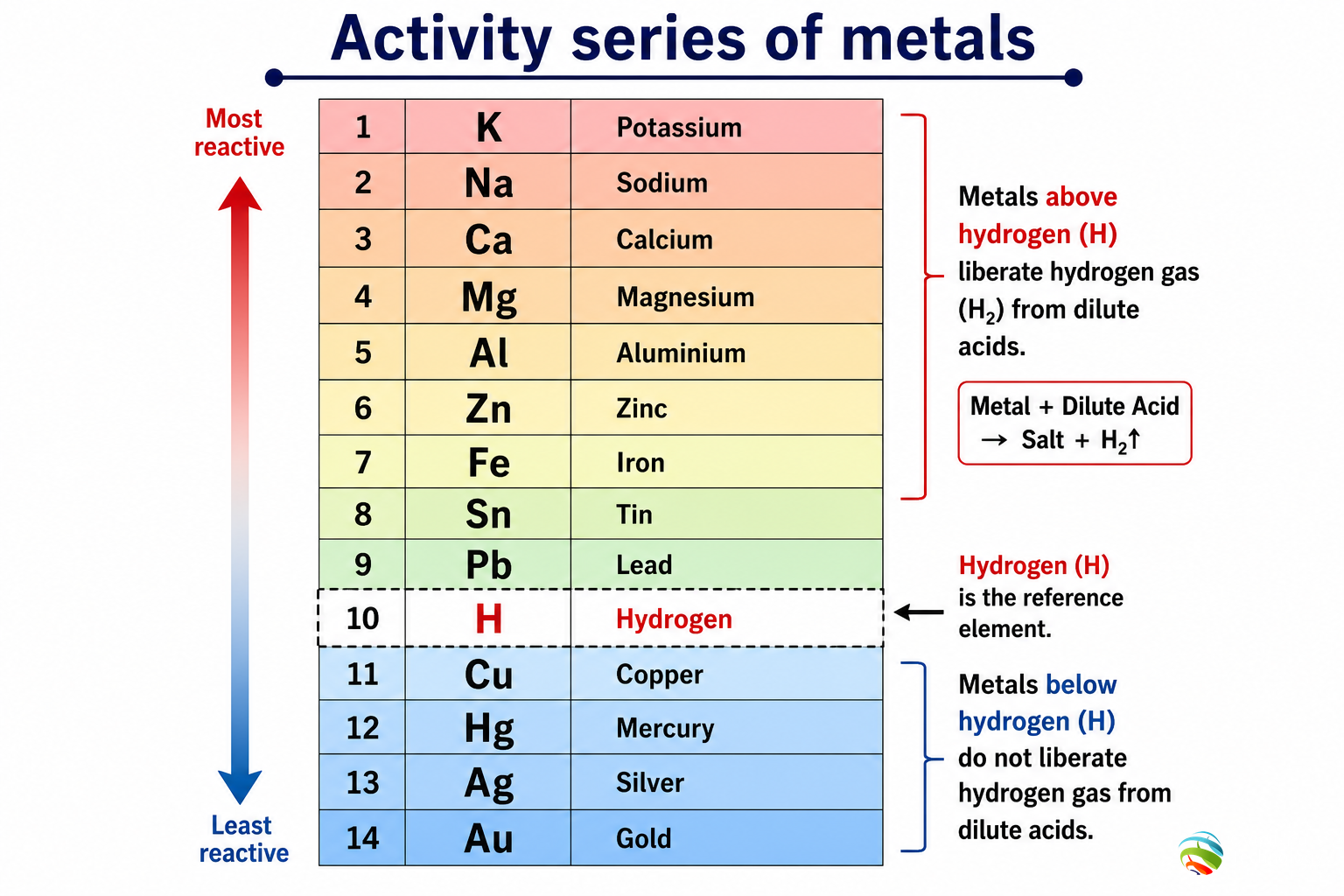
K → Au decreasing reactivity, with hydrogen for acid reference.
Step 1 — Study the figure
Cover the label key on the image, name each numbered part, then check the explanations below.

Step 2 — Diagram details for students
What this diagram shows
The activity series ranks metals from most reactive to least reactive. A metal higher in the series can displace a lower one from salt solution, and metals above hydrogen liberate H₂ from dilute acids. Extraction method also depends on position in the series.
Numbered parts — mark & remember
Match each number on the figure with the meaning below. Say the function aloud once.
1 Top metals (K–Al)
Potassium, sodium, calcium, magnesium and aluminium are highly reactive. They liberate hydrogen from dilute acids and are usually extracted by electrolysis of molten compounds. Store reactive metals carefully because they react with air or water.
2 Middle metals (Zn–Pb)
Zinc, iron, tin and lead are moderately reactive. Their oxides are often reduced by carbon (or sometimes aluminium) in extraction. They still displace less reactive metals from salt solutions when higher in the series.
3 Hydrogen [H]
Hydrogen is placed in the series as a reference for acid reactions, not as a metal. Metals above hydrogen can displace H₂ from dilute acids; metals below cannot. Copper, silver and gold therefore do not liberate hydrogen from dilute HCl.
4 Bottom metals (Cu–Au)
Copper, mercury, silver and gold are least reactive and often found native or easily obtained. They do not displace hydrogen from dilute acids. Gold is so unreactive that it resists corrosion strongly.
How to read this figure
- Higher means more reactive; lower means less reactive.
- For displacement, the added metal must be above the metal in the salt.
- Remember Sn (tin) before Pb — students often skip tin.
Redraw for board marks
- Write the series vertically from K at top to Au at bottom.
- Insert [H] clearly between Pb and Cu.
- Mark “more reactive” at the top arrow.
Board answer tip: Write the series, mark hydrogen, and use it to justify one displacement or acid reaction example.
Exam tips — don’t lose marks
- Displacement questions are solved by comparing two positions only.
- Extraction: top electrolysis, middle reduction, bottom heating/simple methods.
- Do not say copper liberates H₂ from dilute acid.