Formation of ionic bond (NaCl idea)
Metal loses electron(s); non-metal gains — opposite ions attract.
Step 1 — Study the figure
Cover the label key on the image, name each numbered part, then check the explanations below.
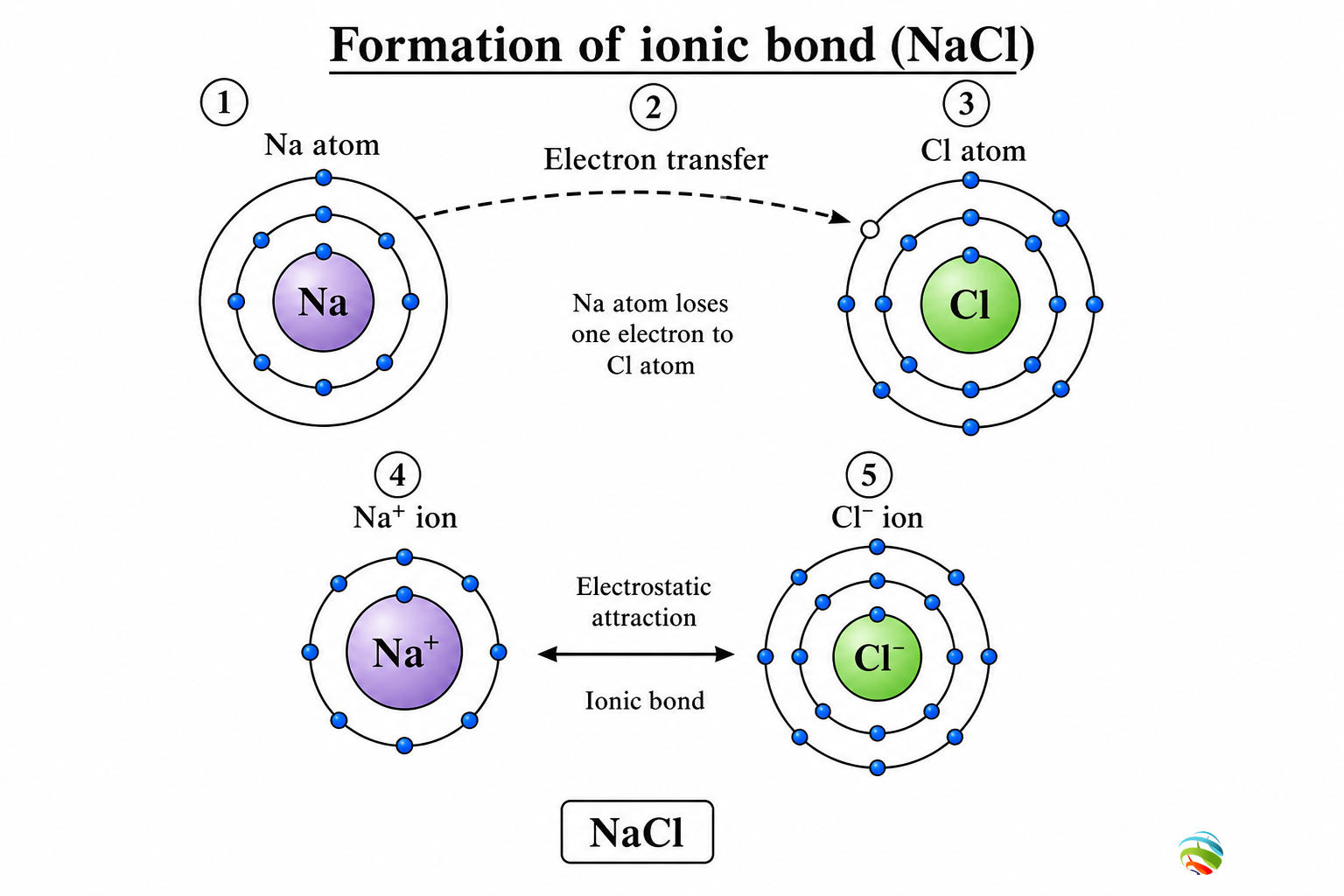

Step 2 — Diagram details for students
What this diagram shows
An ionic bond forms when a metal transfers electron(s) to a non-metal and the resulting opposite ions attract. Sodium chloride is the standard Class 10 model: Na becomes Na⁺ and Cl becomes Cl⁻. Ionic solids are crystalline, high melting, and conduct when molten or aqueous.
Numbered parts — mark & remember
Match each number on the figure with the meaning below. Say the function aloud once.
1 Metal atom
A metal atom has few valence electrons and tends to lose them to gain a stable octet. Sodium has one valence electron and loses it easily. After losing the electron it becomes a positively charged cation.
2 Non-metal atom
A non-metal needs electrons to complete its octet. Chlorine has seven valence electrons and needs one more. After gaining an electron it becomes a negatively charged anion.
3 Electron transfer
The diagram shows the electron moving from metal to non-metal. This transfer is the key difference from covalent sharing. Write “transfer of electron” clearly in definitions.
4 Ionic attraction
Na⁺ and Cl⁻ attract by strong electrostatic force to form NaCl lattice. In solid form ions are fixed, so solid ionic compounds do not conduct electricity. When molten or dissolved, free ions move and conduction occurs.
How to read this figure
- Follow the electron arrow from metal to non-metal.
- Check charges: metal positive, non-metal negative.
- Link structure to properties: high melting point and conductivity conditions.
Redraw for board marks
- Draw Na and Cl atoms with valence shells.
- Show one electron transferring to chlorine.
- Write Na⁺ and Cl⁻ and an attraction arrow between them.
Board answer tip: Explain electron transfer with Na and Cl, show ions formed, and state one property of ionic compounds.
Exam tips — don’t lose marks
- Solid NaCl does not conduct; molten/aqueous NaCl does.
- Ionic compounds are usually soluble in water and have high melting points.
- Do not call NaCl electron sharing — that is covalent language.