Food web (simple)
Interconnected food chains — more stable than a single chain.
Step 1 — Study the figure
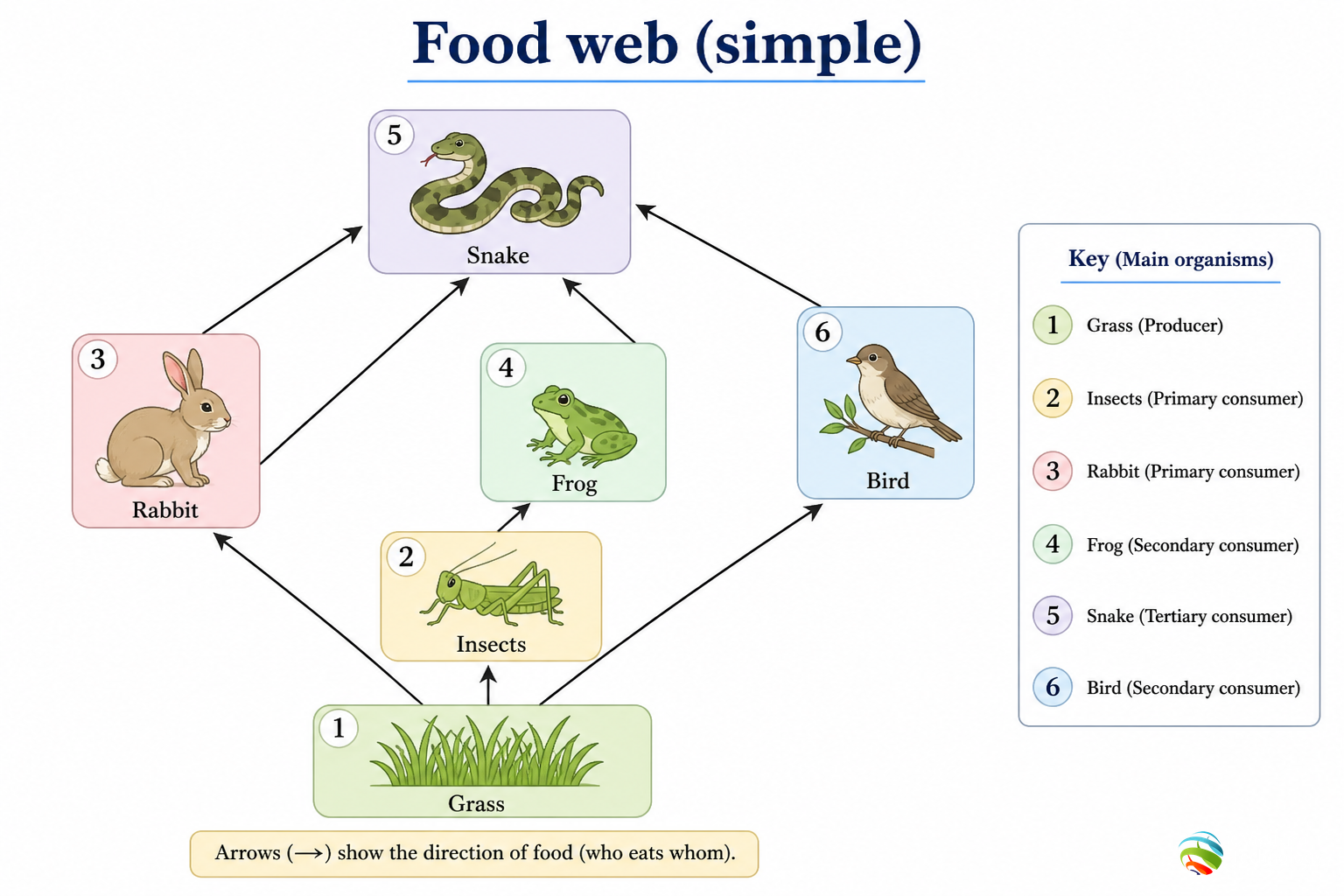
Cover the label key on the image, name each numbered part, then check the explanations below.

Step 2 — Diagram details for students
What this diagram shows
A food web is many interlinked food chains in an ecosystem. Cross-links make the system more stable because if one food source fails, alternatives may remain. Decomposers recycle matter even though energy flow stays one-way.
Numbered parts — mark & remember
Match each number on the figure with the meaning below. Say the function aloud once.
1 Producers
Several plants or algae may act as producers in a web. They support different herbivores at once. More producer variety often supports richer consumer networks.
2 Multiple consumers
One animal can appear in more than one chain, sometimes at different roles. For example, a bird may eat insects and seeds. This overlapping is what builds a web.
3 Interlinking arrows
Arrows still show energy flow toward consumers, but many paths interconnect. The diagram should not look like a single line. Stability comes from these alternative pathways.
4 Stability idea
If one link is removed, other links may still feed some organisms. A single chain is more fragile than a web. Exam answers should contrast chain vs web on stability.
How to read this figure
- Look for cross-connections, not one straight sequence.
- Energy direction remains producer → consumer.
- Mention decomposers when asked about recycling of matter.
Redraw for board marks
- Draw 2–3 producers and several consumers.
- Add multiple cross arrows.
- Caption: food web = interconnected chains.
Board answer tip: Draw a small web and write two differences between food chain and food web.
Exam tips — don’t lose marks
- Web is more stable than a single chain.
- Do not reverse energy arrows.
- Biological magnification still applies along any path up trophic levels.