Common circuit symbols
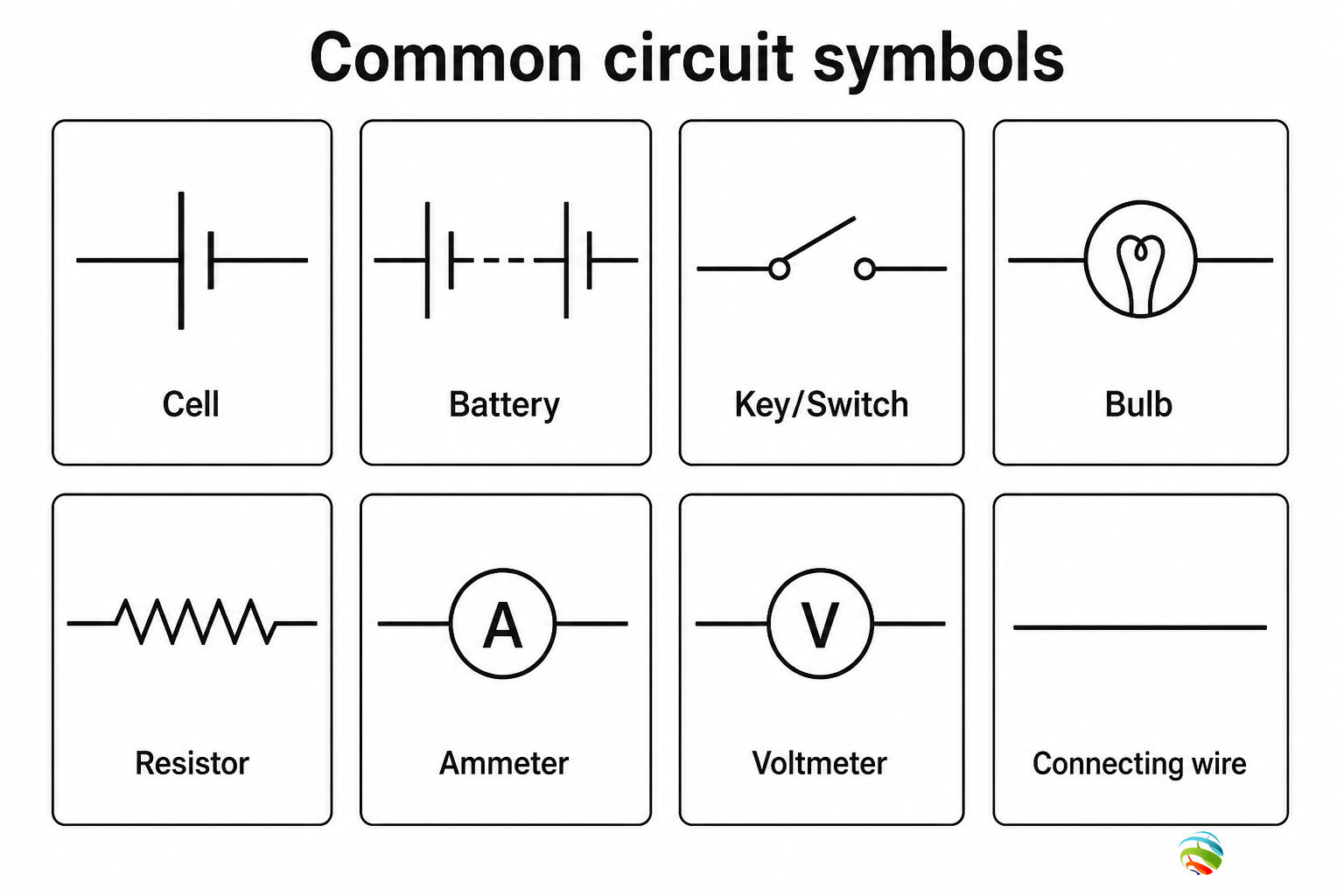
Cell, battery, key, ammeter, voltmeter, resistor, bulb, wire.
Step 1 — Study the figure
Cover the label key on the image, name each numbered part, then check the explanations below.

Step 2 — Diagram details for students
What this diagram shows
Standard circuit symbols let everyone read and draw the same circuit language. Ammeter is always in series and voltmeter in parallel. Correct symbols and meter placement are easy marks in both theory and practical-style questions.
Numbered parts — mark & remember
Match each number on the figure with the meaning below. Say the function aloud once.
1 Cell / battery
A cell provides potential difference that drives current. Longer line is positive terminal in the usual symbol. Battery means cells in series for higher voltage.
2 Key (switch)
A key opens or closes the circuit. Current flows only when the key is closed and the path is complete. Always show an open/closed key correctly in diagrams.
3 Bulb / resistor
These are loads that convert electrical energy to light or heat. Resistor symbol is used for resistance calculations. Label values when numericals need them.
4 Ammeter
Ammeter measures current and must be connected in series with the component. Ideally it has low resistance so it does not change the current much. Wrong placement is a common practical error.
5 Voltmeter
Voltmeter measures potential difference and must be connected in parallel. Ideally it has high resistance so little current diverts through it. Place it across the component of interest.
How to read this figure
- Identify source, control (key), load, and meters.
- Series for ammeter; parallel for voltmeter.
- Conventional current is from + to − outside the cell.
Redraw for board marks
- Make a symbol chart with names.
- Draw one closed series circuit using the symbols.
- Place A in series and V in parallel on a resistor.
Board answer tip: Draw a labelled circuit with cell, key, resistor, ammeter in series, and voltmeter in parallel.
Exam tips — don’t lose marks
- Meter placement mistakes lose practical and theory marks.
- Closed circuit is required for continuous current.
- Learn both cell and battery symbols.