Series vs parallel combination
Series: same current; parallel: same voltage — household prefers parallel.
Step 1 — Study the figure
Cover the label key on the image, name each numbered part, then check the explanations below.

Step 2 — Diagram details for students
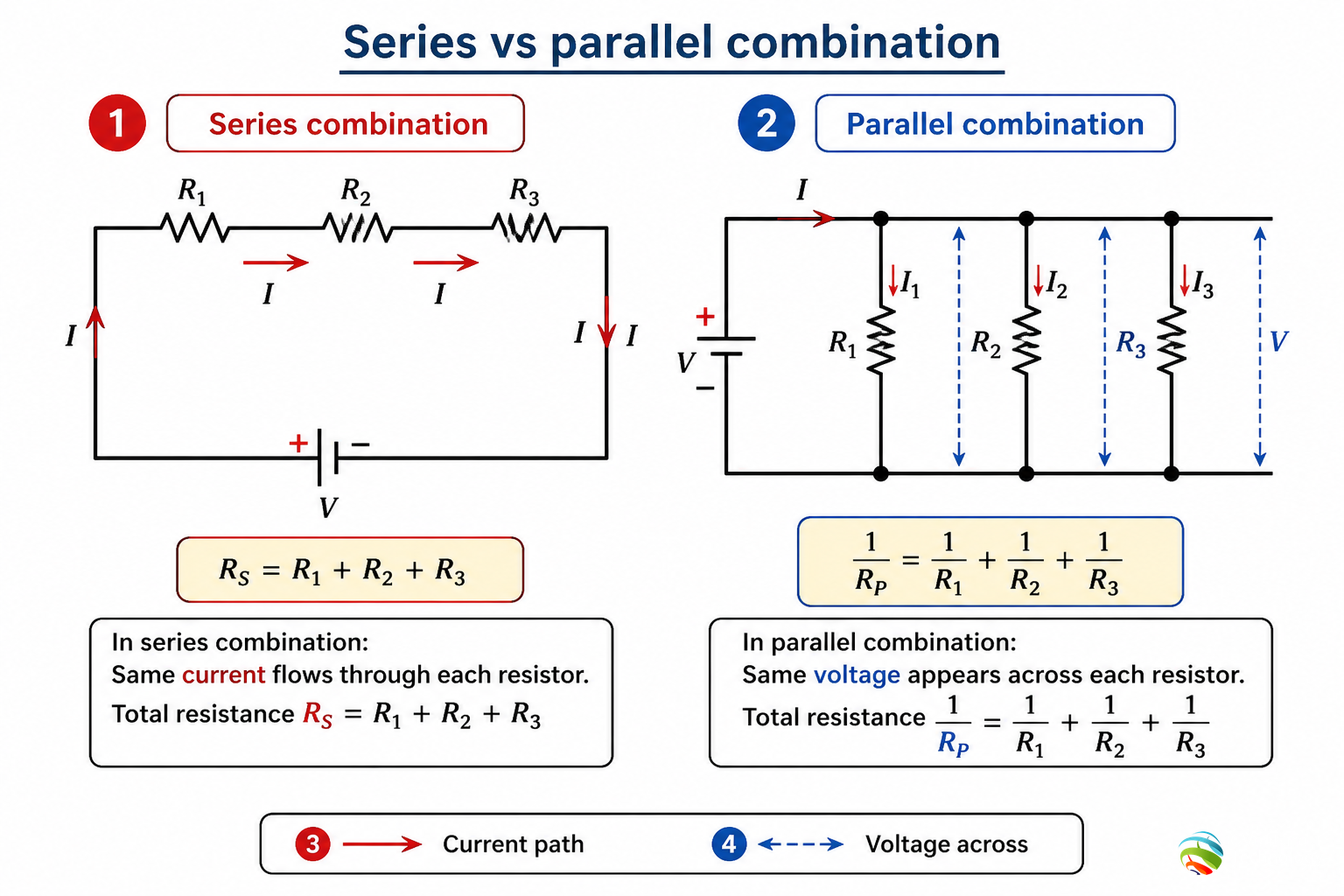
What this diagram shows
Series combination shares the same current while voltages add; parallel combination shares the same voltage while currents add. Household wiring prefers parallel so each appliance gets full voltage and others keep working if one fails. Formulae for Rs and Rp are compulsory.
Numbered parts — mark & remember
Match each number on the figure with the meaning below. Say the function aloud once.
1 Series
In series, the same current flows through every resistor. Total voltage divides across resistors and Rs = R1 + R2 + … Effective resistance becomes larger than any single resistor. If one bulb fuses, the series chain breaks.
2 Parallel
In parallel, each branch gets the same voltage. Currents split among branches and total current is the sum. Effective resistance falls: 1/Rp = 1/R1 + 1/R2 + …
3 Same I vs same V
Remember the contrast line: series → same I; parallel → same V. This single comparison solves many conceptual questions. Use it before writing formulae.
4 Household preference
Homes use parallel circuits so every appliance receives the supply voltage. One appliance can be switched off without stopping others. This is safer and more convenient than series lighting for rooms.
How to read this figure
- Identify connection type from the wiring sketch first.
- Write the matching property and formula.
- Predict what happens if one bulb fails.
Redraw for board marks
- Draw one series and one parallel sketch.
- Annotate same I / same V.
- Write Rs and Rp formulae under each.
Board answer tip: Draw both combinations, state same I/same V, write formulae, and give one household reason.
Exam tips — don’t lose marks
- Rp is less than the smallest individual resistance.
- Series current is common; parallel voltage is common.
- Household = parallel is a standard reason question.