Right-hand thumb rule (straight wire)
Thumb = current; curled fingers = magnetic field circles.
Step 1 — Study the figure
Cover the label key on the image, name each numbered part, then check the explanations below.
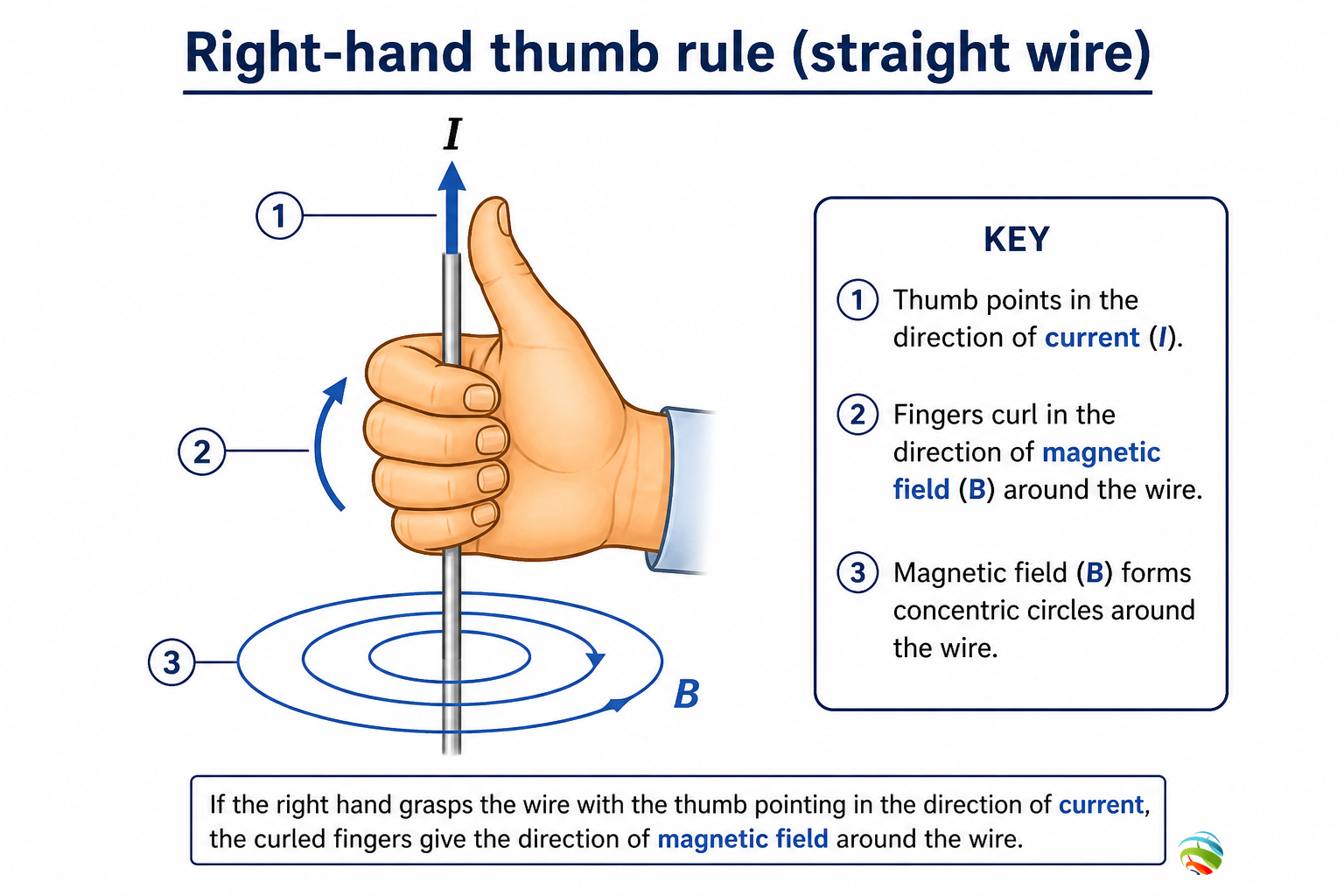

Step 2 — Diagram details for students
What this diagram shows
The right-hand thumb rule gives the magnetic field direction around a straight current-carrying wire. Thumb points in conventional current direction and curled fingers show field circles. Field strength rises with current and falls with distance from the wire.
Numbered parts — mark & remember
Match each number on the figure with the meaning below. Say the function aloud once.
1 Thumb = current
Point your right-hand thumb in the direction of conventional current in the wire. Conventional current is positive-to-negative outside the source. Getting I direction wrong reverses the predicted field.
2 Fingers = field
Curl the fingers of the same hand around the wire. The curl direction is the magnetic field direction. This mnemonic is for straight wires (Oersted effect).
3 Concentric circles
Field lines form concentric circles centred on the wire. Closer circles mean stronger field near the wire. In diagrams, show at least two or three circles with arrows.
4 Strength idea
Larger current gives stronger field; larger distance gives weaker field. Soft-iron cores are for solenoids/electromagnets, not needed for this basic wire rule. Do not confuse with Fleming’s left-hand rule.
How to read this figure
- Identify I direction first, then apply the hand rule.
- Draw circular field arrows consistently.
- Separate this rule from Fleming motor rule.
Redraw for board marks
- Draw a straight wire with I arrow.
- Add concentric circles with direction arrows.
- Sketch a right hand showing thumb and curl.
Board answer tip: State the rule, draw circles around a wire, and give one factor that increases field strength.
Exam tips — don’t lose marks
- Right-hand thumb rule ≠ Fleming’s left-hand rule.
- Oersted’s experiment links current to magnetism.
- State dependence on current and distance.