Magnetic field of a solenoid
Like a bar magnet; strong nearly uniform field inside.
Step 1 — Study the figure
Cover the label key on the image, name each numbered part, then check the explanations below.

Step 2 — Diagram details for students
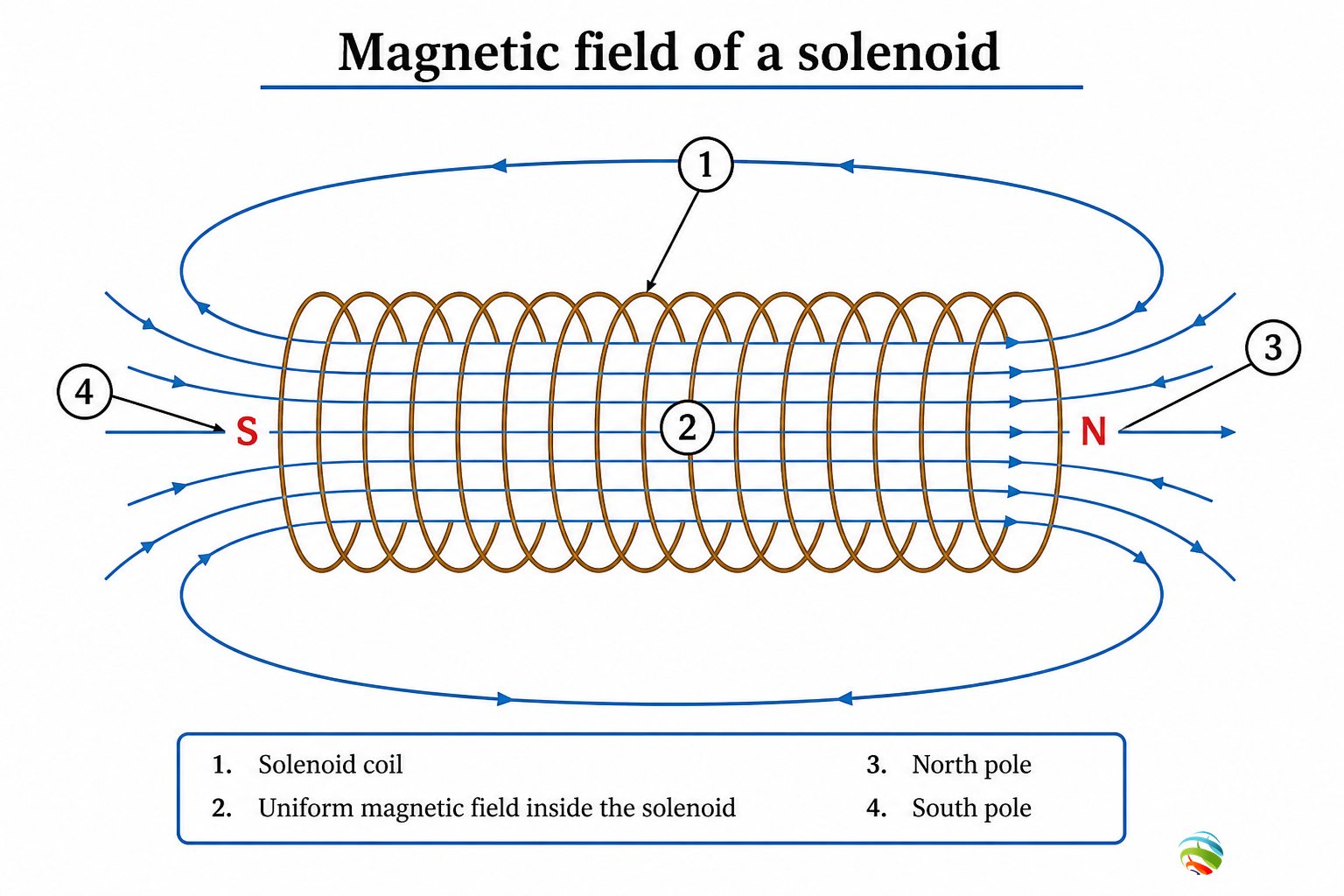
What this diagram shows
A current-carrying solenoid produces a magnetic field like a bar magnet, nearly uniform and strong inside. Soft iron core makes a powerful temporary electromagnet. Polarity of faces depends on current direction around the helix.
Numbered parts — mark & remember
Match each number on the figure with the meaning below. Say the function aloud once.
1 Solenoid coil
A solenoid is a long coil of many turns carrying current. Each turn contributes to the overall field. More turns and more current generally mean stronger magnetism.
2 Uniform field inside
Inside a long solenoid the field is strong and nearly uniform in direction and magnitude. Field lines are almost parallel and equally spaced there. Outside, the field is weaker and similar to a bar magnet pattern.
3 N and S faces
One face of the solenoid acts as north and the other as south. Face polarity can be found with right-hand rules for loops/solenoids. Label N and S in diagrams for full marks.
4 Soft iron core
Inserting soft iron concentrates and strengthens the field, making an electromagnet. Electromagnets are temporary and controllable by switching current. Used in cranes, bells, and relays at awareness level.
How to read this figure
- Inside = uniform; ends = poles like a bar magnet.
- Core + current control = electromagnet advantage.
- Link to bar-magnet field-line properties.
Redraw for board marks
- Draw a helix coil on a horizontal axis.
- Show parallel field lines inside.
- Label N/S ends and optional soft-iron core.
Board answer tip: Draw solenoid field, mark uniform interior, and explain soft-iron electromagnet in two lines.
Exam tips — don’t lose marks
- Uniform inside is a standard one-line fact.
- Electromagnet strength depends on current, turns, and core.
- Temporary magnetism is an advantage over permanent magnets in many devices.