Dispersion through a prism
White light splits into VIBGYOR; violet bends most.
Step 1 — Study the figure
Cover the label key on the image, name each numbered part, then check the explanations below.

Step 2 — Diagram details for students
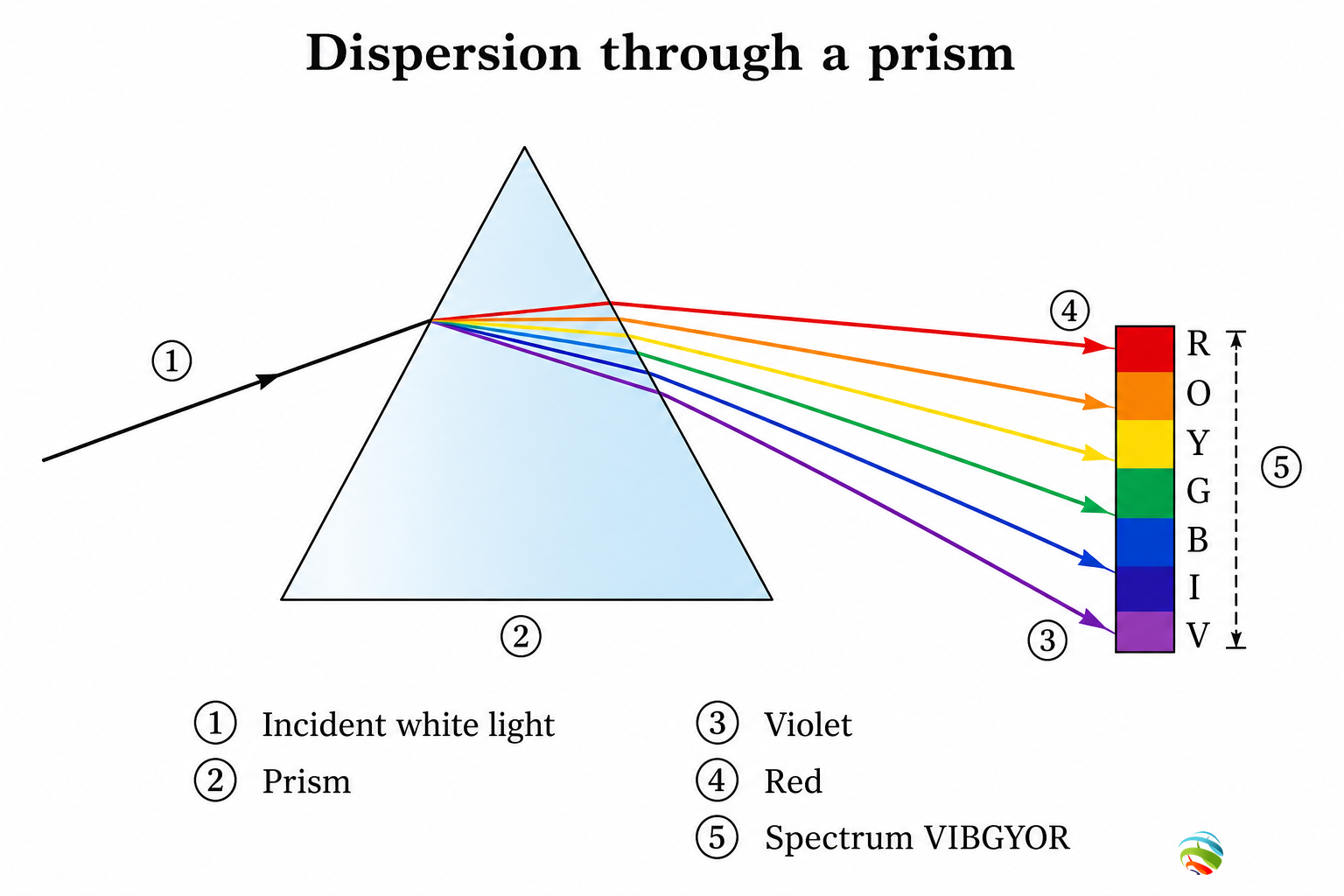
What this diagram shows
Dispersion is splitting of white light into its constituent colours by a prism. Different colours travel at slightly different speeds in glass, so they refract by different amounts. Violet bends most and red least, producing the spectrum.
Numbered parts — mark & remember
Match each number on the figure with the meaning below. Say the function aloud once.
1 White light
White light is a mixture of colours. When it enters a prism, the mixture starts separating. Sunlight is the usual source in rainbow and prism discussions.
2 Prism action
A triangular glass prism refracts light at two surfaces. Because refractive index varies with colour, deviation differs for each colour. This unequal deviation causes dispersion.
3 Violet
Violet light is slowed more in glass and is deviated the most. It appears at one end of the spectrum. Remember “violet most bent” as a fixed board line.
4 Red and spectrum
Red is least bent and appears at the other end. The ordered spread is VIBGYOR. Rainbow formation also involves dispersion in raindrops with reflection.
How to read this figure
- White in → coloured fan out.
- Violet most, red least.
- Dispersion ≠ scattering (blue sky is scattering).
Redraw for board marks
- Draw prism triangle.
- Show white incident ray and emergent spectrum.
- Label violet and red ends clearly.
Board answer tip: Define dispersion, draw prism spectrum, and state which colour bends most and least.
Exam tips — don’t lose marks
- Write VIBGYOR order correctly.
- Recombination with inverted prism can give white light again (NCERT idea).
- Do not explain blue sky using dispersion alone.