Myopia and correction
Image forms before retina; corrected by concave lens.
Step 1 — Study the figure
Cover the label key on the image, name each numbered part, then check the explanations below.

Step 2 — Diagram details for students
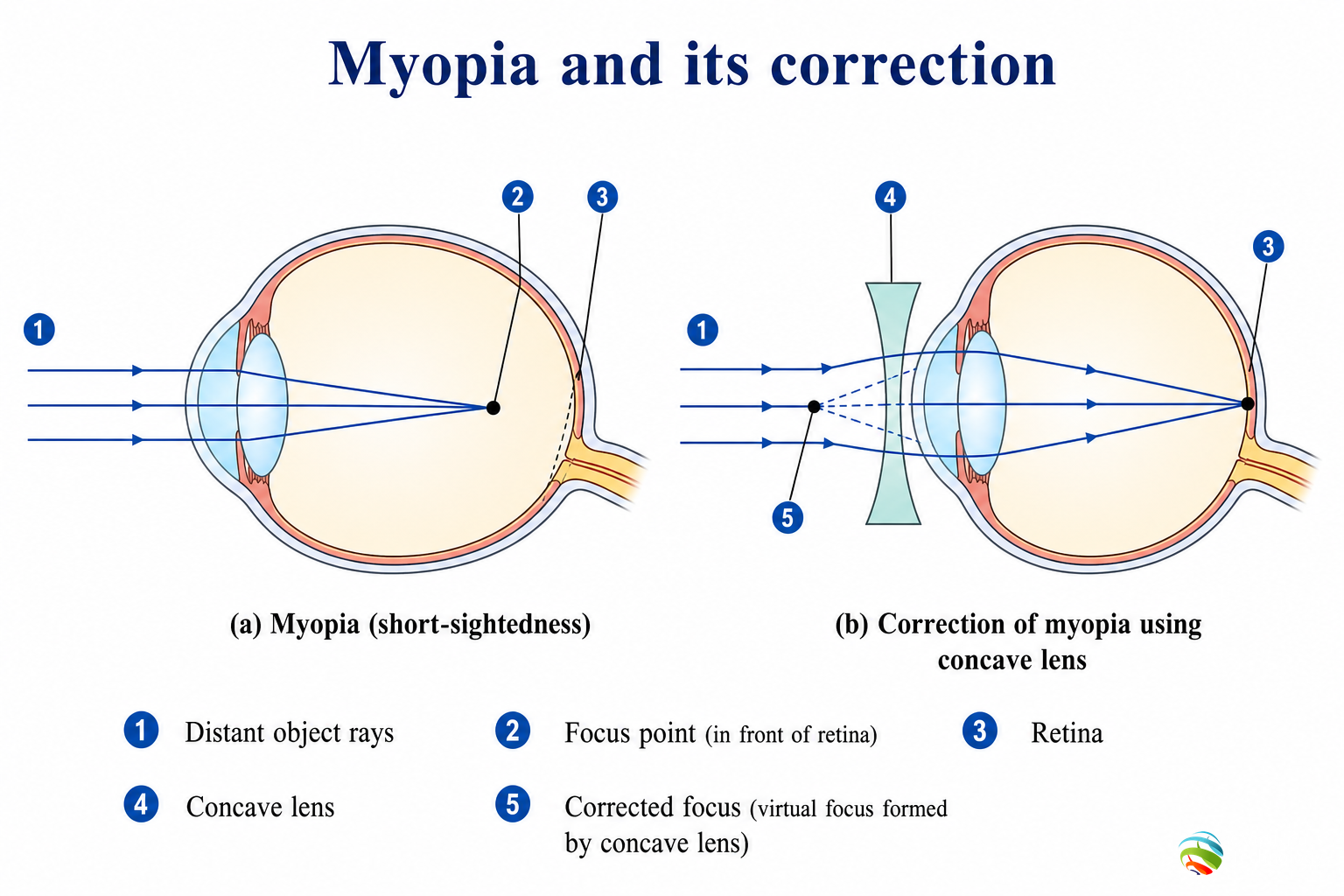
What this diagram shows
Myopia (near-sightedness) means distant objects focus in front of the retina, so far point is nearer than infinity. It is corrected by a concave (diverging) lens. Always show defect and correction panels together in diagrams.
Numbered parts — mark & remember
Match each number on the figure with the meaning below. Say the function aloud once.
1 Defect image
In an uncorrected myopic eye, parallel rays from distant objects meet before the retina. The person sees nearby objects better than distant ones. Far point is closer than infinity.
2 Cause idea
Myopia may be due to an elongated eyeball or a lens that is too converging. Either way, effective power is too high for distant vision. Mention cause briefly if the question asks.
3 Concave lens
A concave lens diverges incoming rays a little before they enter the eye. This pushes the focus backward onto the retina for distant objects. Power of the correcting lens is negative.
4 Corrected focus
After correction, the image of a distant object forms on the retina. Clear far vision is restored while the diagram should still show the eye structure. Bifocals may combine lenses for older people with both defects.
How to read this figure
- Left panel defect, right panel correction is the usual layout.
- Myopia → concave; hypermetropia → convex.
- State far-point idea in words.
Redraw for board marks
- Draw two eye outlines side by side.
- Show focus before retina in defect panel.
- Add concave lens and focus on retina in correction panel.
Board answer tip: Define myopia, give cause, draw defect vs correction, and name concave lens.
Exam tips — don’t lose marks
- Do not swap concave/convex with hypermetropia.
- Write “diverging lens” or “concave lens” clearly.
- Mention far point for definition marks.