Hypermetropia and correction
Image forms behind retina; corrected by convex lens.
Step 1 — Study the figure
Cover the label key on the image, name each numbered part, then check the explanations below.

Step 2 — Diagram details for students
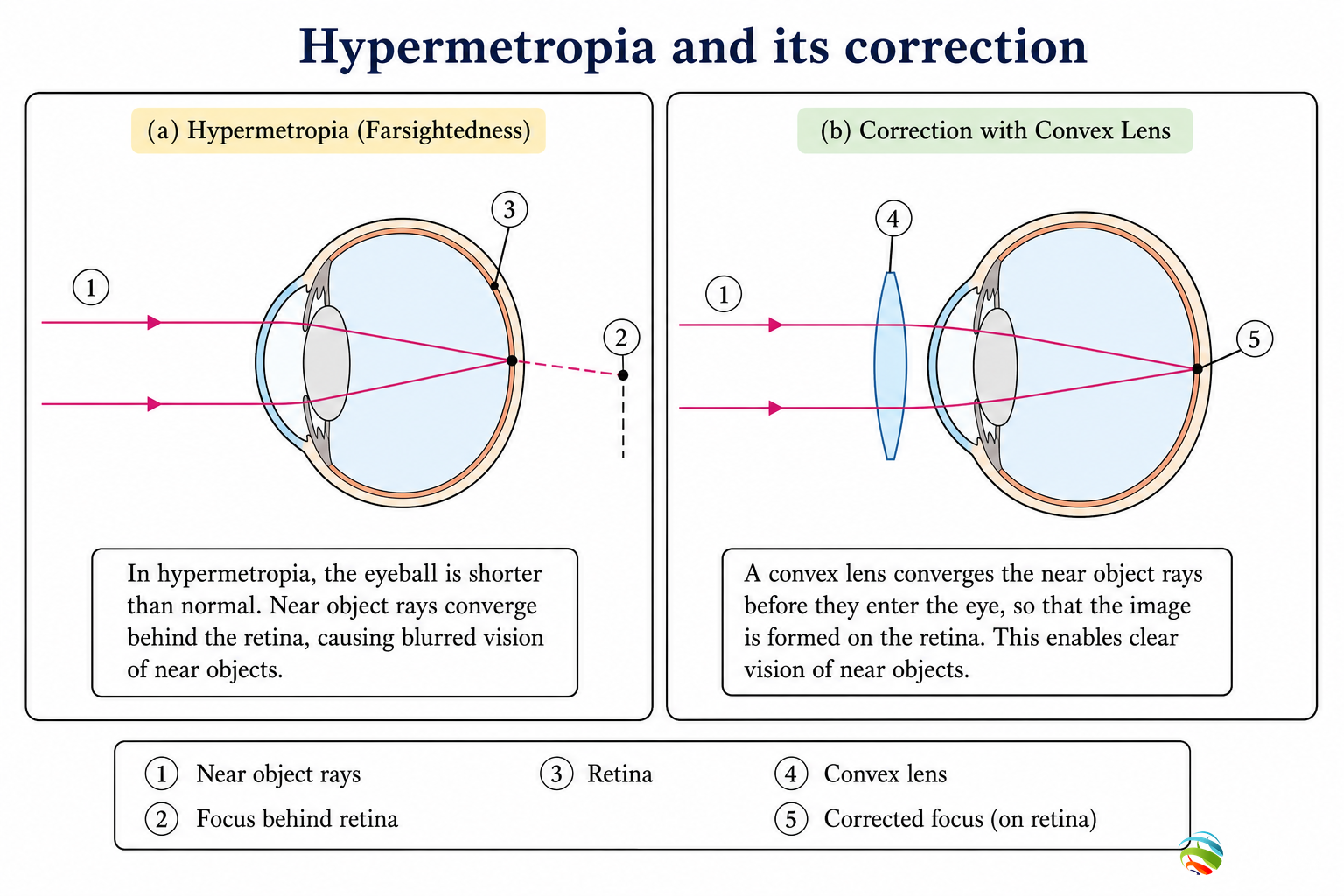
What this diagram shows
Hypermetropia (far-sightedness) means near objects tend to focus behind the retina, so near point is farther than 25 cm. It is corrected by a convex (converging) lens. Contrast it carefully with myopia in exams.
Numbered parts — mark & remember
Match each number on the figure with the meaning below. Say the function aloud once.
1 Defect image
In uncorrected hypermetropia, near-object rays would focus behind the retina. Nearby reading becomes difficult while distant vision may be better. Near point shifts farther than the normal 25 cm.
2 Cause idea
The eyeball may be too short or the eye lens too weak (less converging). Effective power is insufficient for near work. State cause if asked in the question.
3 Convex lens
A convex lens adds converging power before the eye. Rays then meet on the retina for near objects. Correcting lens power is positive.
4 Corrected focus
With the convex lens, near images form on the retina and reading improves. Show both defect and correction in one neat figure pair. Keep labels large for marking.
How to read this figure
- Hypermetropia = near point too far; needs converging help.
- Convex corrects hypermetropia; concave corrects myopia.
- Compare near-point statements carefully.
Redraw for board marks
- Draw defect panel with focus behind retina.
- Draw correction panel with convex lens.
- Label near-point idea in a short caption.
Board answer tip: Define hypermetropia, state cause, and draw convex-lens correction with focus on retina.
Exam tips — don’t lose marks
- Do not mix lens type with myopia.
- Definition should mention near point greater than 25 cm.
- Give cause + correction for full 3-mark structure.