Step 1 — Study the figure
Cover the label key on the image, name each numbered part, then check the explanations below.

Step 2 — Diagram details for students
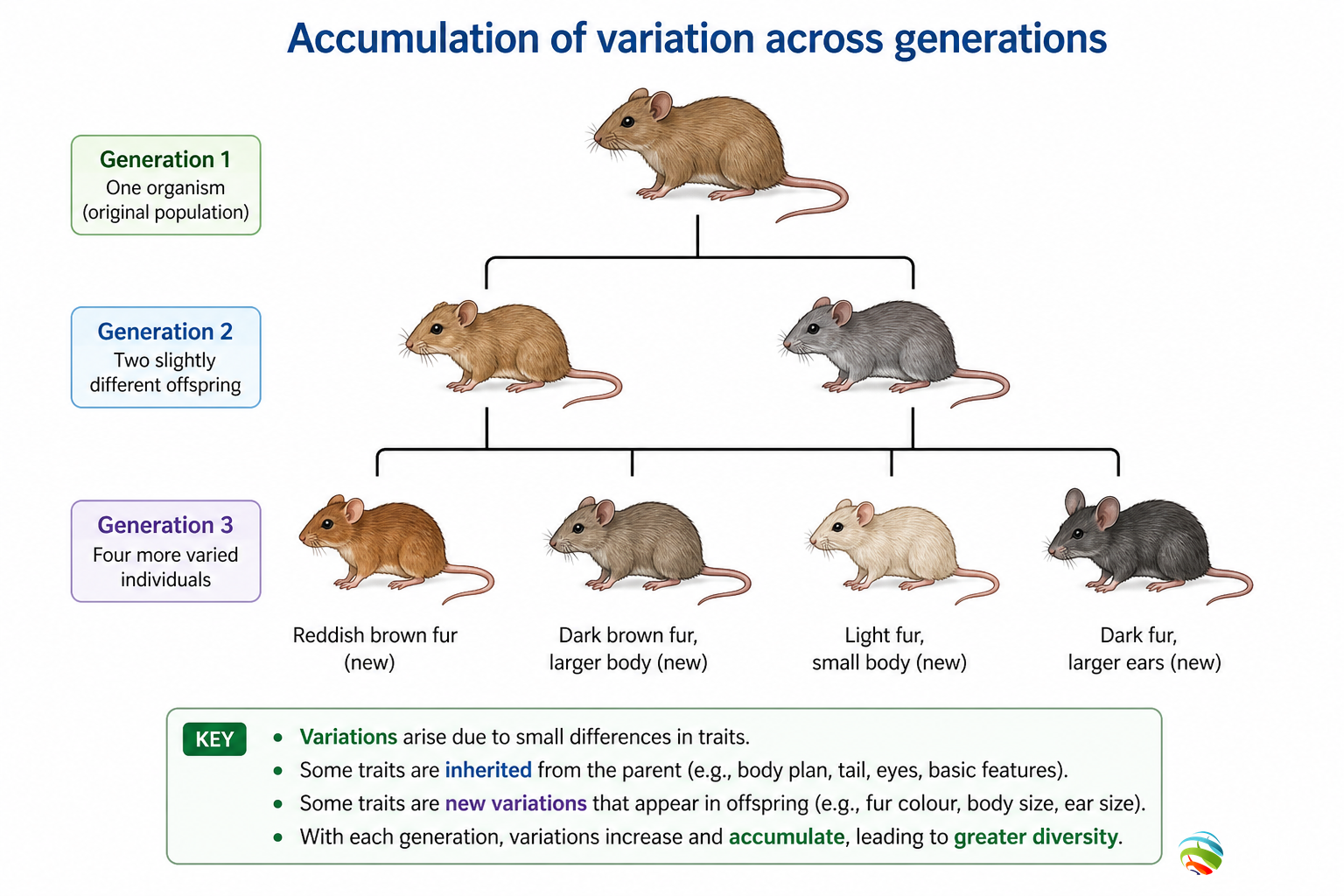
What this diagram shows
This tree shows how small differences accumulate across generations. Offspring inherit a common design plus variations, and new variations keep appearing. Environment then selects which variants survive better.
Numbered parts — mark & remember
Match each number on the figure with the meaning below. Say the function aloud once.
1 Parent
The starting organism has a basic body design coded by DNA. Reproduction passes that design onward. Even early on, tiny differences can exist between individuals.
2 Next generation
Each child gets inherited differences plus newly created copy variations. Asexual reproduction gives fewer differences than sexual mixing. Still, imperfect DNA copying always adds some variation.
3 Later generations
As generations continue, differences pile up and diversity expands. Some traits become common if they arose earlier and spread. The tree shape helps visualise branching diversity.
4 Selection idea
Not every variant survives equally well. Environment favours advantageous variants, such as heat-tolerant bacteria in a heat wave. This selection idea links heredity to evolution discussions.
How to read this figure
- Read downward as time and accumulating variation.
- Sexual branches are more diverse than asexual ones.
- Selection acts on existing variation.
Redraw for board marks
- Draw one parent, then two children, then four grandchildren.
- Mark small differences at each level.
- Add a caption on accumulation of variation.
Board answer tip: Draw the diversity tree and explain inherited + new variation in two short paragraphs.
Exam tips — don’t lose marks
- Variation is raw material; environment selects.
- Sexual reproduction increases diversity more than asexual.
- Earlier-arising traits can be more common in asexual populations (NCERT thinking style).