Step 1 — Study the figure
Cover the label key on the image, name each numbered part, then check the explanations below.

Step 2 — Diagram details for students
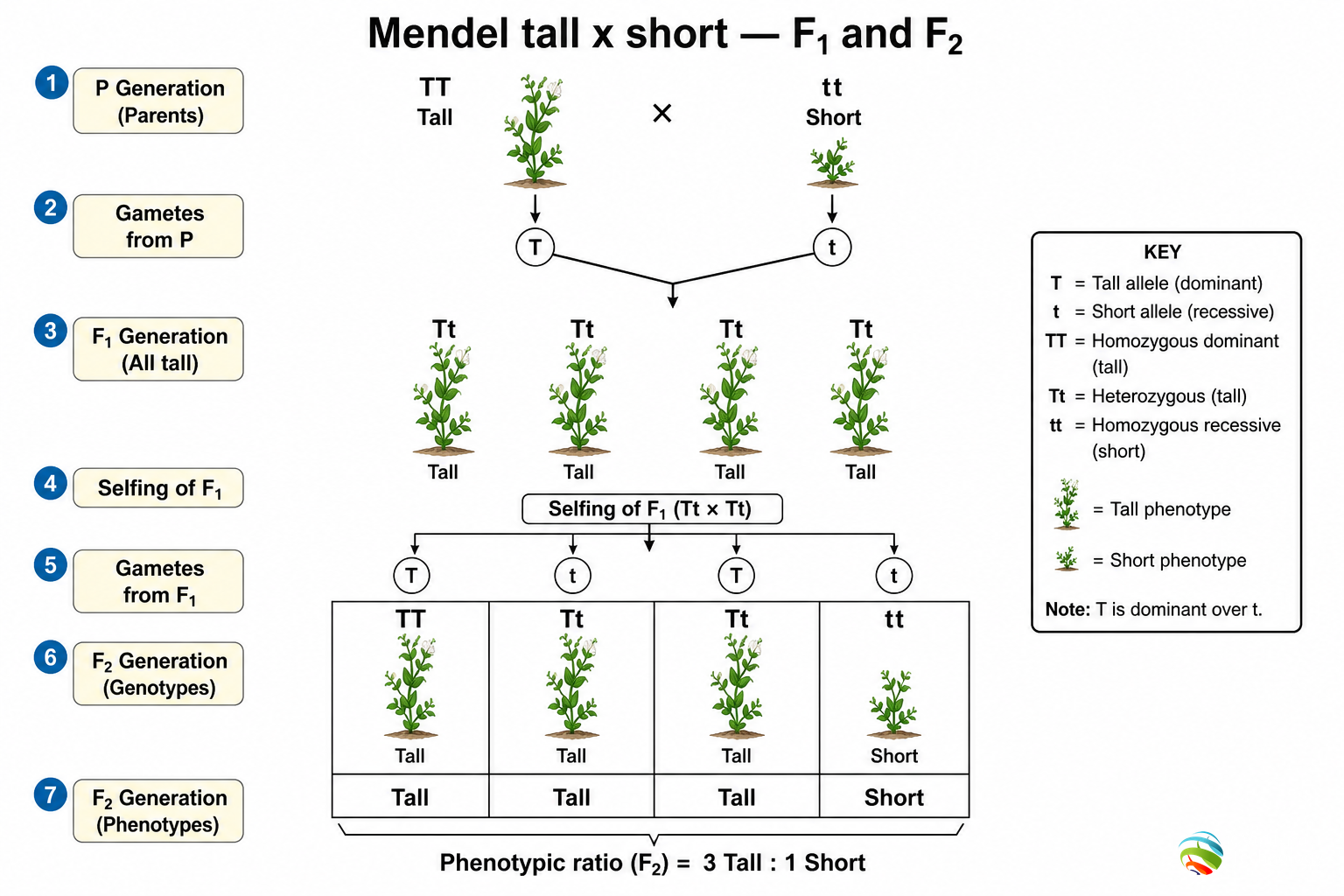
What this diagram shows
Mendel’s tall × short cross shows dominant and recessive inheritance with clear ratios. F1 is all tall (Tt), and F2 gives about three tall to one short. Genotypes TT, Tt, and tt explain why recessive traits return.
Numbered parts — mark & remember
Match each number on the figure with the meaning below. Say the function aloud once.
1 Parents TT × tt
Pure tall TT crossed with pure short tt gives a contrasting parental pair. Each contributes one allele to offspring. This purity is why F1 results are uniform.
2 F1 all Tt
All F1 plants are Tt and appear tall. Tall is dominant, so the recessive short allele is hidden but present. No blending to medium height occurs.
3 F2 genotypes
Selfing F1 produces TT, Tt, Tt, and tt among F2. Genotype idea is 1:2:1 for TT:Tt:tt. Only tt shows the short phenotype.
4 Phenotype 3:1
Phenotypically about three plants are tall and one is short. This 3:1 ratio is the classic monohybrid result. Always state phenotype and genotype ideas separately if asked.
How to read this figure
- Dominant appears in F1; recessive returns in F2.
- Tt is tall, not medium.
- Ratios are approximate counts from many offspring.
Redraw for board marks
- Draw parents → F1 → F2 flowchart.
- Write alleles on each generation.
- Box the 3:1 phenotype ratio clearly.
Board answer tip: Write parental genotypes, F1 result, F2 ratio, and one sentence defining dominant trait.
Exam tips — don’t lose marks
- No blending inheritance in Mendel’s pea traits.
- Recessive can be carried hidden in heterozygotes.
- Show working with alleles, not only words tall/short.