Reproduction modes map
Asexual modes vs sexual path in plants and humans.
Step 1 — Study the figure
Cover the label key on the image, name each numbered part, then check the explanations below.

Step 2 — Diagram details for students
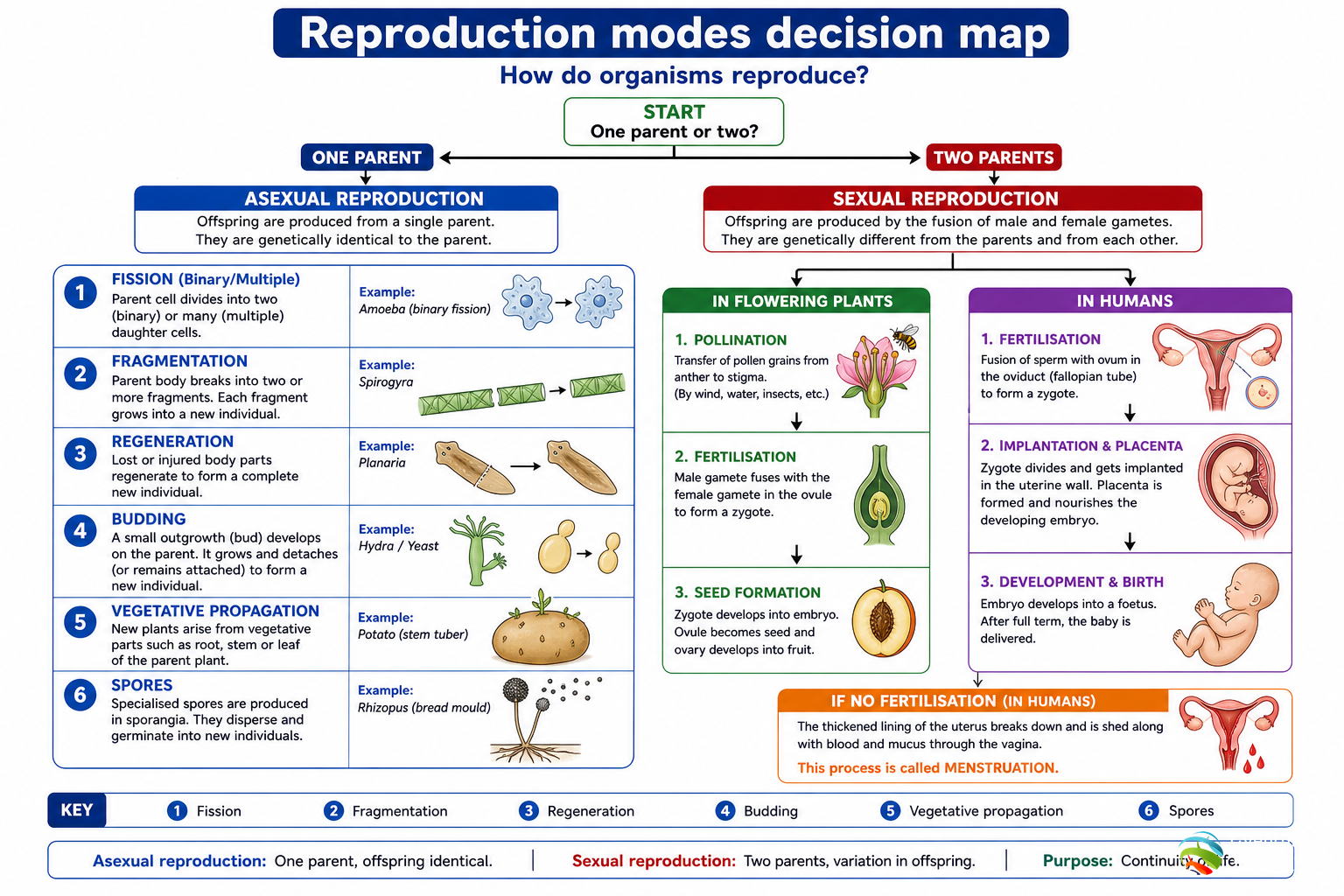
What this diagram shows
Reproduction modes split into asexual (one parent) and sexual (gamete fusion). Class 10 expects clear examples for fission, fragmentation, regeneration, budding, vegetative propagation, and spores, plus flowering-plant and human sexual paths. Do not place budding under fission or treat regeneration as ordinary reproduction.
Numbered parts — mark & remember
Match each number on the figure with the meaning below. Say the function aloud once.
1 Fission
Fission is splitting of a unicellular organism into daughters. Binary fission gives two cells (Amoeba); multiple fission gives many (Plasmodium). Nucleus division is followed by cytoplasm division.
2 Fragmentation
In fragmentation, a multicellular filament breaks into pieces and each piece grows. Spirogyra is the standard example. It works in simple body organisations.
3 Regeneration
Regeneration is regrowth of a whole organism from a body piece, as in Planaria. Specialised cells proliferate and organise into missing parts. It is not the organism’s normal everyday reproductive strategy.
4 Budding
Budding forms an outgrowth that matures and detaches, seen in Hydra and yeast. Yeast budding is not classified as fission in Class 10. Keep budding as its own asexual mode.
5 Vegetative propagation
New plants grow from roots, stems, or leaves, such as potato eyes or Bryophyllum leaf buds. Offspring are genetically similar to the parent. Useful for seedless plants and faster fruiting.
6 Spores / Sexual
Spores (e.g. Rhizopus) are resistant units that grow when conditions suit. Sexual reproduction needs gamete fusion and creates more variation. In humans, fertilisation is usually in the oviduct; no fertilisation leads to menstruation.
How to read this figure
- First decide one parent or two.
- Then pick the exact asexual mode with one example.
- For sexual path, separate pollination from fertilisation.
Redraw for board marks
- Draw two big branches: Asexual and Sexual.
- List six asexual modes with one example each.
- Add plant and human sexual sub-branches.
Board answer tip: Give mode definition + one example + one key point (advantage or caution) for full marks.
Exam tips — don’t lose marks
- Budding ≠ fission.
- Regeneration ≠ normal reproduction.
- Condoms help against many STDs; copper-T/pills prevent pregnancy but not STDs.