Structure of a nephron
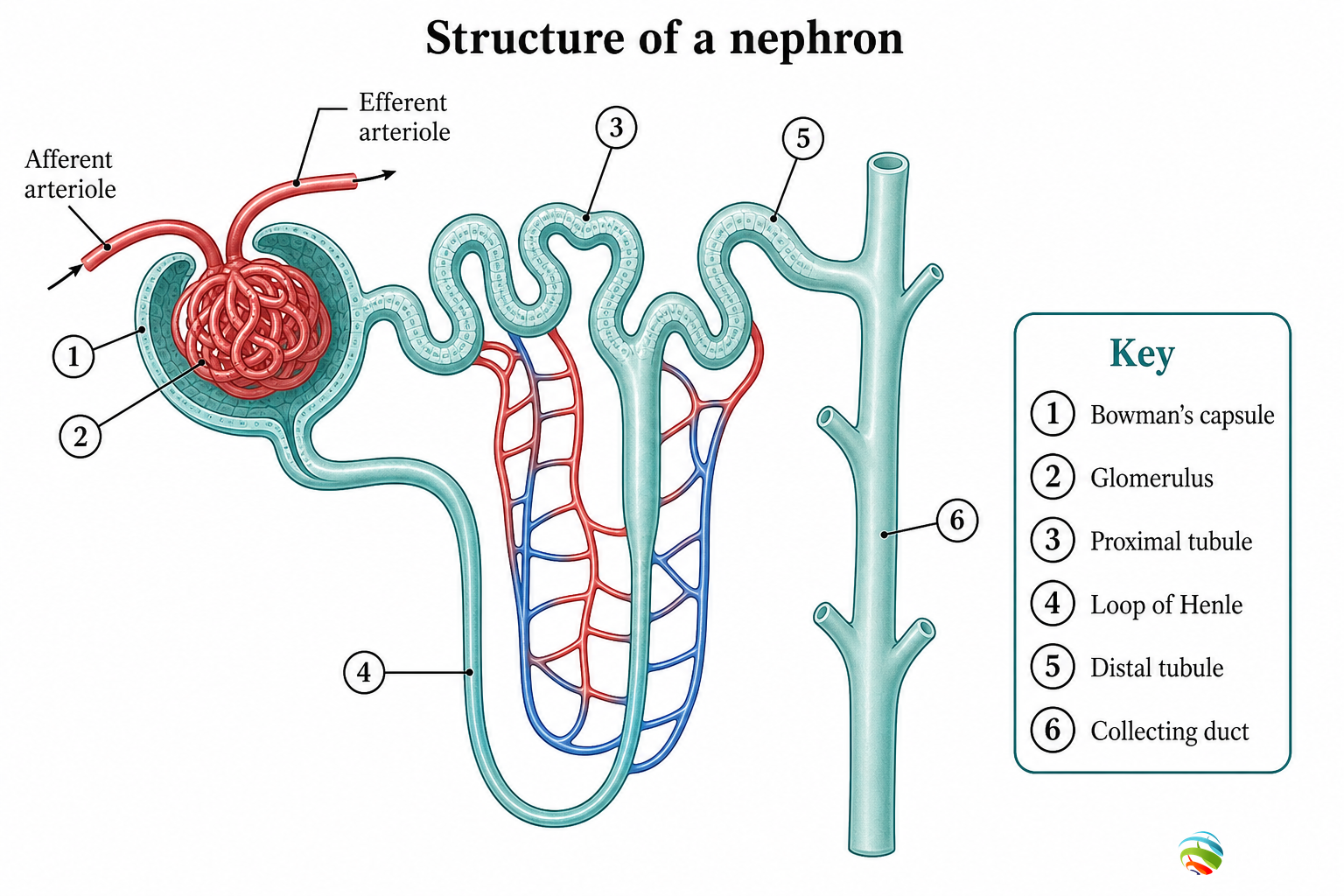
Filtration in Bowman’s capsule; selective reabsorption in tubule.
Step 1 — Study the figure
Cover the label key on the image, name each numbered part, then check the explanations below.

Step 2 — Diagram details for students
What this diagram shows
The nephron is the kidney’s filtration unit that forms urine. Blood is filtered at the glomerulus, then useful substances are selectively reabsorbed in the tubule. Dialysis can remove wastes artificially but cannot match living selective reabsorption.
Numbered parts — mark & remember
Match each number on the figure with the meaning below. Say the function aloud once.
1 Glomerulus
The glomerulus is a knot of capillaries where high pressure forces filtration of blood. Water, urea, salts, and glucose leave the blood as filtrate. Blood cells and proteins normally stay in the blood.
2 Bowman's capsule
Bowman’s capsule is the cup-shaped structure that collects the filtrate. It surrounds the glomerulus closely. From here filtrate enters the nephron tubule.
3 Tubule
Along the tubule, useful substances are taken back into blood by selective reabsorption. Glucose, amino acids, some salts, and much water are recovered as needed. This step makes urine composition different from initial filtrate.
4 Collecting duct
The collecting duct gathers urine from nephrons and sends it toward the pelvis. Urine then flows through ureter to bladder and out via urethra. Water reabsorption here also helps control urine volume.
How to read this figure
- Two key words: filtration then selective reabsorption.
- Follow afferent flow into glomerulus and filtrate down the tubule.
- Contrast living nephron with dialysis when asked.
Redraw for board marks
- Draw glomerulus inside Bowman’s capsule.
- Extend a coiled tubule to a collecting duct.
- Label filtration and reabsorption zones.
Board answer tip: Draw and label nephron parts, then explain filtration and selective reabsorption in two short paragraphs.
Exam tips — don’t lose marks
- Dialysis has no selective reabsorption like a real nephron.
- Excretion removes metabolic wastes; egestion removes undigested food.
- Do not say all filtrate becomes urine — much is reabsorbed.