Stomata (open and closed)
Guard cells control the pore for gas exchange and transpiration.
Step 1 — Study the figure
Cover the label key on the image, name each numbered part, then check the explanations below.

Step 2 — Diagram details for students
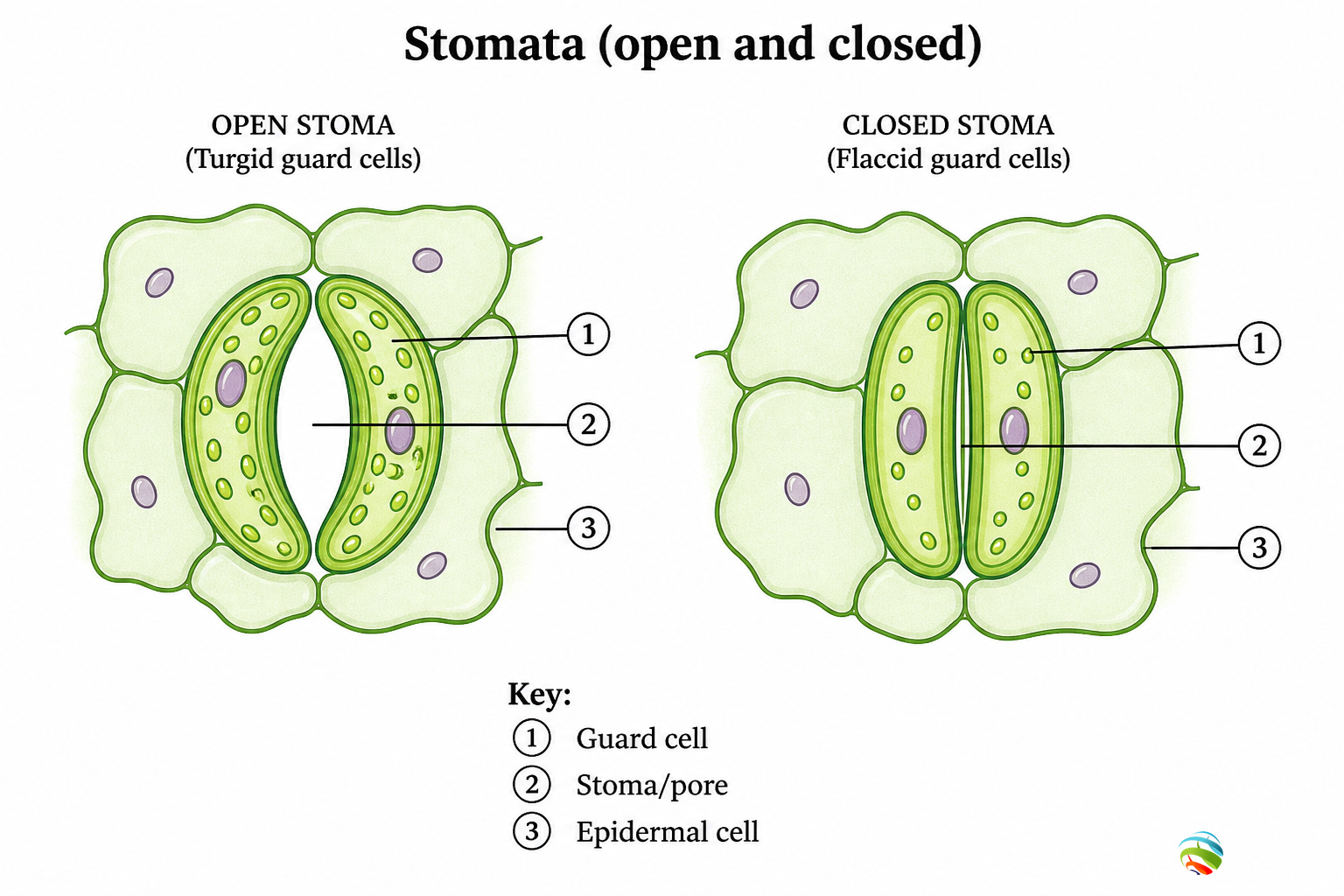
What this diagram shows
Stomata are tiny leaf pores controlled by guard cells. They open for carbon dioxide entry but also lose water by transpiration. Exam diagrams must show open versus closed states with turgid and flaccid guard cells.
Numbered parts — mark & remember
Match each number on the figure with the meaning below. Say the function aloud once.
1 Guard cells
Guard cells are kidney-shaped cells that border the stomatal pore. Unlike ordinary epidermal cells, they contain chloroplasts. Their shape change opens or closes the pore.
2 Stomatal pore
The pore is the actual opening through which gases and water vapour move. CO₂ enters for photosynthesis; O₂ and water vapour can leave. Pore size is not fixed — it depends on guard-cell turgidity.
3 Epidermal cells
Epidermal cells form the leaf skin around the stoma. They usually lack chloroplasts and mainly protect the leaf. In diagrams, show them as neighbouring cells outside the guard cells.
4 Open (turgid)
When guard cells take in water they become turgid and the pore widens. This favours gas exchange for photosynthesis. It also increases water loss, so plants balance the need carefully.
5 Closed (flaccid)
When guard cells lose water they become flaccid and the pore shrinks or closes. This reduces transpiration during water stress. Closing saves water but can limit CO₂ entry.
How to read this figure
- Compare the two panels: open = turgid; closed = flaccid.
- Always mention guard cells when explaining stomatal action.
- Link opening to photosynthesis need and closing to water conservation.
Redraw for board marks
- Draw two kidney-shaped guard cells facing each other.
- Show a wide pore for open and a narrow pore for closed.
- Label guard cell, pore, and epidermal cell on both sides.
Board answer tip: Draw open and closed stomata side by side, label parts, and explain turgid vs flaccid control.
Exam tips — don’t lose marks
- Write turgid/flaccid mechanism for full marks.
- Guard cells have chloroplasts; ordinary epidermal cells usually do not.
- Transpiration is water vapour loss, mainly through stomata.